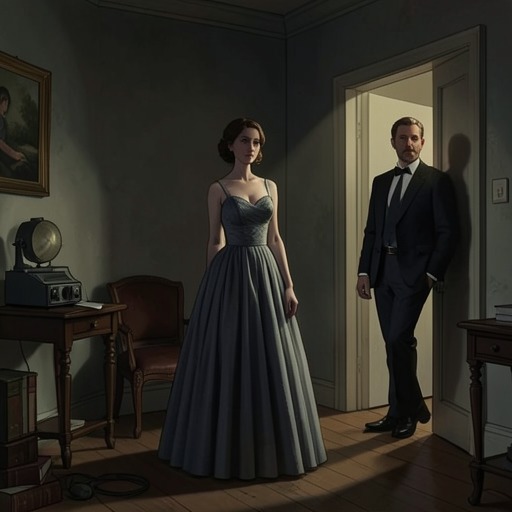
Teodoro Tells Débora He Is Óscar’s Father
Gente que viene y ¡Bah!Teodoro Tells Débora He Is Óscar’s Father begins with an unwelcome claim at the family home and develops into a fraught negotiation over what fatherhood means. Teodoro arrives with flowers and says he is willing to take responsibility for Óscar; Débora insists that the child is hers and refuses him access. Their later conversation at Bar Caribe reveals a more complicated motive: Teodoro is trying to claim a place in his son’s life, even as Débora resists making room for him.
The Unexpected Visit
The announcement arrives in the middle of a strained family gathering. The narrator’s father answers the door, accompanied by Gollum, the three-legged dog, whose frantic barking and wagging make him seem like the only happy presence in the house. Returning visibly perplexed, the father reports that a dwarf is outside with a bouquet of flowers, asking for Débora. Her face changes through several colors in seconds, signaling how abruptly the visitor has unsettled her.
Débora goes outside and tells Teodoro that her mother must have caused a misunderstanding. When he says he is prepared to accept his share of responsibility if Óscar is his son, she denies the possibility and says she does not even know his name. The confrontation is private only briefly: the narrator watches from an upstairs window after Débora shuts the door behind her, and the exchange continues within sight of the family home.
The Disclosure and the Meeting at Bar Caribe
Outside, Teodoro makes the claim explicit: he says Débora paid him three hundred euros for sex, that he did not use a condom, and that Óscar carries his genes. Débora responds by accusing him of having had sex with her without a condom and of having entered her life as a sex worker; she also threatens to report him. The exchange turns the question of paternity into a dispute over both responsibility and consent. Teodoro insists that he has come not to obtain anything from her but to take responsibility. Débora counters that Óscar is hers alone and that Teodoro will get nothing by appearing at her door. When he asks whether he may at least see the boy, she refuses. The roses, he explains, are for her.
The confrontation does not end the matter. A later mysterious package contains a note asking Débora to meet its sender at ten that night at Bar Caribe, with a playful contingency involving a shirt if she has not arrived by half past ten. Débora eventually reads it, and she and her sister head to the bar where she had arranged to meet Teodoro. The note’s teasing tone contrasts with the hostility of their first encounter, but the meeting remains charged: Débora arrives wondering whether he has changed his mind or is already wearing the promised shirt.
At Bar Caribe, Teodoro explains that he is studying psychology and hopes to support himself through that work, although he expects it will take time to earn a living from the profession. He says that, as a nurse, he has struggled to find work because employers see his short stature; meanwhile, he continues performing at hen parties. Débora asks whether that is how he intends to provide for Óscar when he cannot even produce the three hundred euros. Teodoro replies that he can take more bookings, then work in whatever job he can find after finishing his degree, and promises the child will not lack anything. His insistence makes fatherhood an intention he is prepared to work toward, not a claim backed by financial security.
Débora still rejects the role he is asking to take. She says she does not want him to assume responsibility for her son, who already has a mother and a family. While allowing that Teodoro may be a good man, she interprets his determination as a desperate attachment to the chance to become a father, and suggests that he may eventually meet a woman with similar interests and form a family with her instead. Their meeting therefore leaves the central conflict unresolved: Teodoro offers commitment, while Débora treats his biological connection as insufficient reason to admit him into Óscar’s life.
The Limits of Teodoro’s Claim
The scene distinguishes between biological paternity and an accepted place in a family. Teodoro presents Óscar’s genetic connection to him as grounds for responsibility, but Débora does not treat that connection as an entitlement: she disputes his claim, refuses a meeting with the child, and says Óscar already has a mother and family. Teodoro’s offers—to provide for the boy and to take responsibility—cannot by themselves settle what Débora regards as a decision about access and belonging. The episode therefore stops short of reconciliation or recognition. Its gestures of courtship, from the flowers at the door to the teasing note, make the encounter less forbidding, but they do not resolve the central dispute: Teodoro is ready to call himself a father, while Débora is not ready to make room for him as one.
Thresholds and the Narrator’s View
The episode is framed through partial access rather than a single private conversation. At the family home, the narrator hears of Teodoro’s arrival and later watches Débora speak to him from an upstairs window, close enough to witness the dispute but not to join it. The later move to Bar Caribe shifts the encounter from the family’s doorway to a place Débora has agreed to meet him, while her sister accompanies her. These changes in setting give the episode its shape: Teodoro can present himself and his claim, but neither the family home nor the bar makes Débora’s acceptance automatic.